 Roger Gnanih
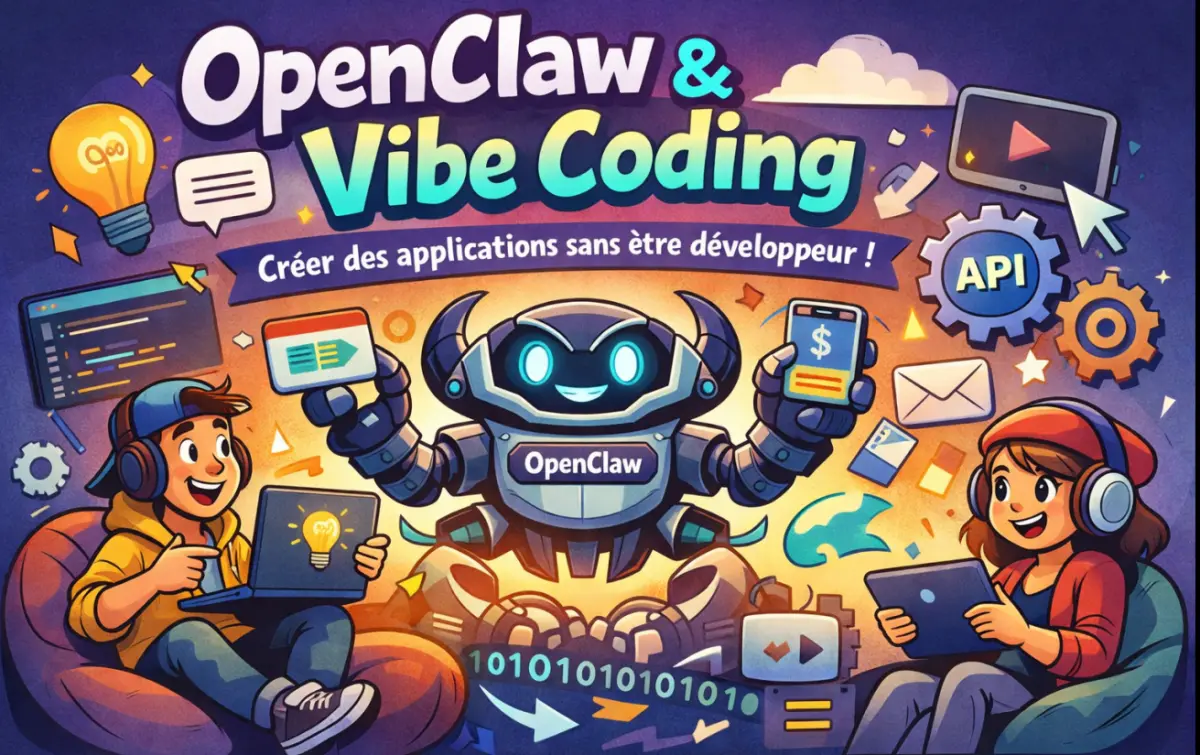
OpenClaw and Vibe Coding: building applications without being a professional developer
Artificial intelligence is profoundly changing the way digital products are designed. Today, a new approach called Vibe Coding makes it possible to build applications by working directly with AI, without manually writing every line of code.
In this context, open source tools like OpenClaw make it possible to automate the creation of features, orchestrate intelligent agents and easily connect different services.
Understanding Vibe Coding
Vibe Coding means developing an application by simply describing the features you want. The AI then generates the code, suggests architecture structures and helps implement the different parts of the project.
The goal is no longer just to program, but rather to clearly define the product you want to build.
This approach lets you focus more on:
- business logic
- user experience
- product innovation
Artificial intelligence then acts as a development assistant able to turn ideas into working code.
The role of OpenClaw
OpenClaw is an open source framework for creating AI agents that can interact with different tools and external services.
Thanks to this type of architecture, it becomes possible to design automated systems capable of:
- analyzing a user request
- calling external APIs
- triggering automatic actions
- orchestrating several services at once
For example, an OpenClaw agent can:
- receive information from a web application
- analyze the request with an AI model
- retrieve data from an API
- automatically send a WhatsApp notification or an email
This type of automation makes it possible to build intelligent applications much faster.
Building a product without being a developer
With Vibe Coding and frameworks like OpenClaw, the barrier to entry for creating a digital product becomes much lower.
Today, a person can:
- create a web platform
- automate business processes
- connect several services together
- build intelligent assistants
The user then becomes more of a solution designer than a simple programmer.
They define the rules, interactions and goals of the system, while AI and automation tools take care of executing the technical tasks.
The limits of this approach
Even if these technologies simplify the creation of applications, some skills remain essential:
- understanding a system's architecture
- organizing a project properly
- handling security and performance
- fixing errors when necessary
Vibe Coding does not replace professional developers. However, it greatly speeds up the creation of prototypes and digital products.
A new way to create products
With the rapid evolution of artificial intelligence and open source tools, software development is entering a new phase.
Frameworks like OpenClaw make it possible to design intelligent systems that interact with several services and automate complex processes.
The future of development could be a balance between:
- human creativity
- artificial intelligence
- automation of technical tasks
In this ecosystem, Vibe Coding appears as a new way to quickly turn an idea into a working product.